
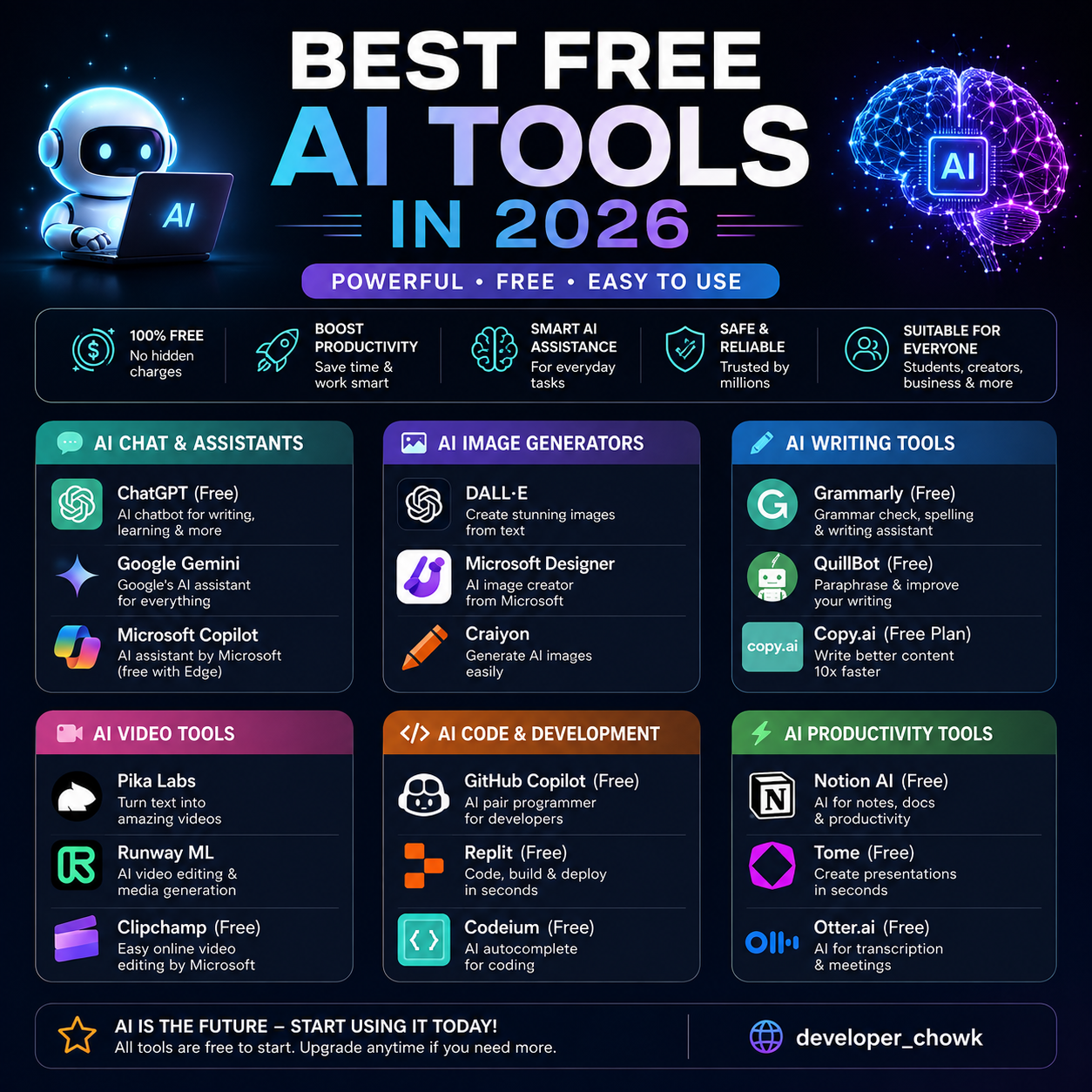
In 2026, the artificial intelligence landscape has reached a point of hyper-maturity. While enterprise budgets are dominated by expensive premium subscriptions, savvy developers, creators, and business professionals are realizing they do not need to spend hundreds of dollars a month to access elite-tier AI. The current generation of free AI tools—ranging from highly capable open-source local models to generous free tiers of premier cloud LLMs—offers unprecedented power for zero cost.
However, the real-world challenge has shifted from "finding" these tools to "orchestrating" them. Without a clear strategy, users face strict rate limits, fragmented workflows, and subpar outputs. This tutorial solves that bottleneck. We will guide you through maximizing the best free AI platforms of 2026 (including Hugging Face, Ollama, Google Gemini Free, Claude Free, and v0.dev) using optimized, copy-pasteable system prompts designed to extract premium performance from zero-cost engines.
The Core AI Prompts
To bypass the limitations of free-tier AI models and unlock advanced reasoning, you must use highly structured, context-rich prompting. The following copy-pasteable prompts are engineered to work flawlessly on free versions of ChatGPT, Claude, Gemini, and local open-source models like Llama 3.3 or Mistral running via Ollama.
1. The Multi-Agent Workflow Simulator
Use this prompt on free LLM interfaces to force a single model to act as an entire software development or product team, reducing the need for expensive multi-agent subscription platforms.
You are an elite, multi-agent AI system operating under a single interface. Your goal is to solve the user's prompt by simulating a collaborative team of experts.

For the given objective, instantiate three distinct personas:
1. Lead Architect (defines the structure, technical stack, and system design)
2. Senior Security & QA Engineer (identifies vulnerabilities, edge cases, and optimizations)
3. Technical Writer (packages the final output into clean, production-ready delivery)

Run a step-by-step collaborative discussion between these three agents. Do not stop until they reach a consensus. Present the final, unified solution under the heading "Consensus Production-Ready Output".

Objective to solve: [INSERT YOUR TASK HERE]
2. The Premium Code Refactoring & Security Auditor
This prompt is designed for free coding engines (such as GitHub Copilot Free, Cline, or Double.bot) to perform enterprise-grade code optimization without requiring paid static analysis licenses.
Act as a Senior Principal Engineer and Static Code Analysis tool. I am running this on a free tier, so your output must be incredibly concise, high-impact, and directly actionable.

Analyze the following code block for:
1. Memory leaks or runtime inefficiencies
2. Security vulnerabilities (OWASP Top 10)
3. Readability and compliance with modern design patterns (SOLID principles)

Provide the output in three sections:
- "The Critical Fixes" (a bulleted list of urgent changes)
- "The Optimized Code" (the complete refactored code block with inline comments explaining key changes)
- "Performance Delta" (estimated memory/CPU improvements in markdown table format)

Code to analyze:
[INSERT YOUR CODE HERE]
3. Context-Insulated SEO Content Strategist
Maximize free writing models (like Gemini 1.5 Flash/Pro free tier) to generate deep, SEO-optimized copy that avoids the generic "AI voice" without requiring paid writing suites.
You are an expert SEO Specialist and Conversion Copywriter. Your task is to generate an in-depth, authoritative section for the topic provided below.

To ensure this bypasses typical AI generation patterns and ranks highly on search engines:
1. Use an active voice and vary your sentence lengths dynamically (Burstiness).
2. Avoid generic transition words (e.g., "In conclusion", "Furthermore", "Crucial", "Tapestry").
3. Integrate highly contextual semantic keywords related to the primary topic.
4. Structure the content with clear heading hierarchies and bullet points for skimmability.

Primary Keyword: [INSERT KEYWORD]
Target Audience: [INSERT AUDIENCE]
Core Topic Outline: [INSERT DETAILS]
Examples & Expected Results
To understand the power of these prompts when paired with free tools, let's look at what happens when you run the Multi-Agent Workflow Simulator inside a free instance of Claude or ChatGPT.
Input Scenario: A user asks the Multi-Agent prompt to build a lightweight, serverless user-authentication script for a Next.js application using local storage and JWTs.
When run on a standard free model, the typical output is a simple, insecure code snippet. However, using our specialized prompt, the model outputs a structured interaction:
- The Lead Architect defines a secure JWT implementation, proposing HttpOnly cookies as a fallback to prevent XSS attacks.
- The Security Engineer intervenes, pointing out that local storage is vulnerable to cross-site scripting and rewrites the cookie-setting header middleware.
- The Technical Writer consolidates their mutual findings into a single, highly commented, production-ready directory structure and code file.
The resulting output is not just code; it is an enterprise-grade architectural blueprint generated for free by forcing the model into a rigorous self-correction loop.
Top Use Cases
Mastering these free tools and advanced prompts allows you to replace several expensive SaaS subscriptions instantly. Here is where you can save the most time and money:
1. Zero-Cost Software Prototyping
By leveraging the free tiers of frontend generation platforms like v0.dev or Bolt.new alongside local LLMs running via Ollama, developers can scaffold, style, and debug complete web applications without spending a dime on hosting, design, or premium generation credits.
2. Local Data Processing and Privacy Compliance
Running local open-source models (such as Llama 3.1 8B or Mistral 7B) using LM Studio allows startups to process sensitive client data, analyze spreadsheets, and summarize proprietary PDFs locally on their hardware. This completely bypasses the need for paid, enterprise-grade cloud security contracts.
3. High-Volume Editorial Workflows
Utilizing the API free tiers of platforms like Groq (which offers blazing-fast inference speeds) or Google AI Studio allows content creators to automate translation, formatting, metadata generation, and content expansion pipelines at zero cost.
Common Mistakes to Avoid
While free AI tools are incredibly powerful, they come with architectural limitations. Avoid these common pitfalls to keep your workflows efficient:
- Exposing Sensitive Data to Public Free Tiers: Most free consumer interfaces (like standard ChatGPT or Gemini Web) use your inputs to train their models. The Fix: Go to your settings and opt out of data sharing, or use local offline tools like Ollama for proprietary code and personal data.
- Ignoring "Context Window" Limitations: Free tiers often have shorter memory windows than their paid counterparts. If you paste a massive codebase, the model will silently forget the beginning of your prompt. The Fix: Break your tasks into modular steps and feed the AI small, context-insulated code blocks.
- Blind Trust in "Zero-Shot" Outputs: Free models can occasionally struggle with reasoning logic on complex tasks. The Fix: Always use few-shot prompting (providing 1 or 2 examples of your preferred output format within your prompt) to keep the AI aligned.
Frequently Asked Questions
Are local AI tools truly free to run?
Yes. Tools like Ollama, LM Studio, and Jan.ai are completely free and open-source. They run entirely on your local computer's hardware (GPU/CPU), meaning you do not need an internet connection or an API subscription key to use them.
What is the best free AI tool for generating web UI components in 2026?
The free tier of v0.dev (by Vercel) remains the industry gold standard for generating modern React, Tailwind CSS, and Shadcn UI components directly from natural language prompts.
How do I bypass the message limits on free cloud LLMs?
The most effective strategy is tool rotation. When you hit a rate limit on Claude Free, pivot your active prompt to Google Gemini Free or use a free developer API key via an open-source desktop client like LibreChat.


