
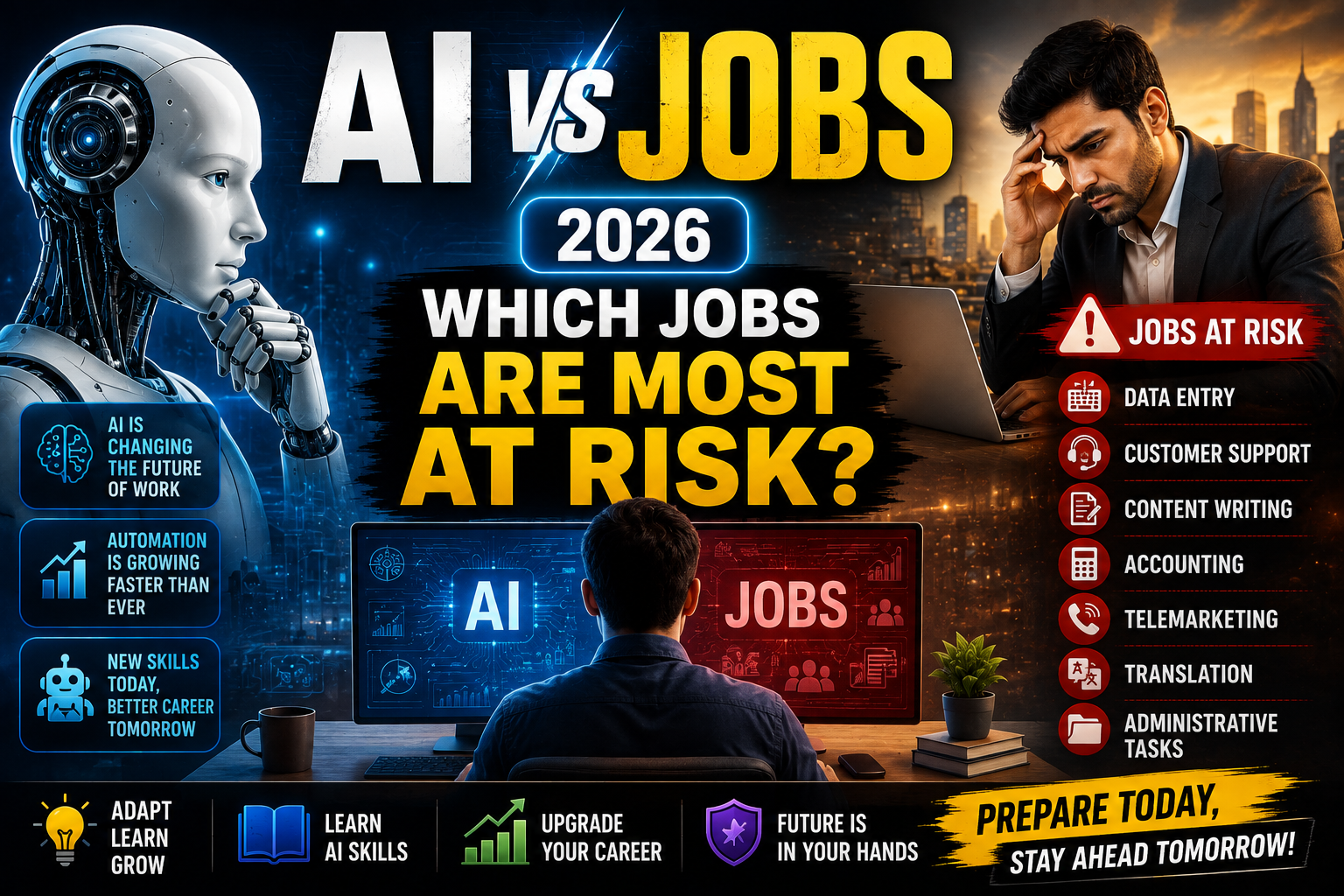
AI vs Jobs 2026: Which Jobs Are Most at Risk?
Artificial Intelligence is changing the job market faster than many people expected.
From customer support and data entry to software development, accounting, marketing, and research, AI tools are now capable of performing many tasks that previously required human workers.
This has created one of the biggest career questions of 2026:
Will AI take our jobs?
The answer is more complicated than a simple yes or no.
AI is already automating certain tasks, while at the same time creating new roles, increasing productivity, and changing the skills employers are looking for.
In this article, we will explore the jobs most at risk from AI in 2026, the jobs that are relatively more resilient, which careers are changing fastest, and what workers and students can do to stay competitive.
🤖 Is AI Really Replacing Jobs in 2026?
AI is definitely changing employment, but the biggest impact so far is often happening at the task level.
Instead of an entire job disappearing overnight, companies may automate certain repetitive responsibilities within that job.
For example:
A customer-support employee may still exist, but AI can handle basic questions.
A software developer may still be needed, but AI can generate code, write tests, and find certain bugs.
An accountant may still be required, but software can automate data entry, reconciliation, and routine reports.
This distinction is important.
Recent analysis from the World Economic Forum emphasizes that AI is changing the relationship between human workers and technology rather than simply creating a straightforward "humans versus AI" scenario.
🔥 10 Jobs Most at Risk From AI in 2026
Not every occupation faces the same level of AI exposure.
Jobs with repetitive, predictable, digital, and rules-based tasks are generally more vulnerable to automation.
Here are some of the areas facing significant pressure.
1. 📊 Data Entry Jobs
Data entry is one of the clearest examples of work that can be automated.
Traditional data-entry tasks often involve:
- Entering information into systems
- Copying information between documents
- Updating records
- Processing forms
- Organizing structured data
AI-powered document processing and automation software can increasingly handle these tasks.
Risk Level: 🔴 High
However, employees who move beyond data entry into data analysis, data quality, automation, or business intelligence can become more valuable.
2. 📞 Basic Customer Support & Call Centre Jobs
AI chatbots and voice assistants can handle many simple customer questions.
For example:
💬 "Where is my order?"
💳 "How do I reset my password?"
📦 "What is your return policy?"
These questions can often be answered automatically.
This means basic Tier-1 customer support roles may face increasing automation pressure.
At the same time, complex customer problems still require human judgment, empathy, negotiation, and escalation.
Risk Level: 🟠 Medium-High
Better Skills to Learn:
🤖 AI customer-service tools
🧠 Problem solving
💬 Communication
📊 Customer analytics
👥 Relationship management
3. 📝 Basic Content Writing
AI can generate:
- Blog drafts
- Product descriptions
- Social media captions
- Basic emails
- Simple articles
- Marketing variations
This means generic content production is becoming easier to automate.
However, this does not mean all writers are going to disappear.
High-quality writers who specialize in:
🎯 Research
🧠 Original analysis
📚 Technical writing
📢 Brand strategy
✍️ Storytelling
🔎 SEO strategy
can remain valuable.
Risk Level: 🟠 Medium-High for basic content
The safest strategy is to become an AI-assisted content creator, rather than competing with AI purely on writing speed.
4. 📋 Routine Administrative Jobs
Administrative work often includes repetitive digital tasks.
Examples include:
📧 Scheduling
📄 Document processing
📊 Spreadsheet updates
📝 Data organization
📨 Email sorting
📋 Record management
AI assistants and workflow automation tools can increasingly perform parts of these responsibilities.
Risk Level: 🟠 Medium-High
Administrative professionals can reduce their automation risk by learning:
⚙️ Workflow automation
📊 Advanced Excel
🤖 AI tools
📈 Data analysis
💬 Communication
📋 Project management
5. 💰 Basic Accounting & Bookkeeping
Accounting is another field being transformed by automation.
Software can already assist with:
💵 Transaction categorization
📊 Financial reports
🧾 Invoice processing
🔄 Reconciliation
📑 Expense management
This puts pressure on highly repetitive bookkeeping tasks.
However, accounting professionals who specialize in:
📈 Financial analysis
💼 Business strategy
⚖️ Tax expertise
🔍 Auditing
📊 Financial planning
can provide higher-value services that require human judgment.
Risk Level: 🟠 Medium
6. 🔎 Basic Research & Information Gathering
AI can search, summarize, classify, and organize large amounts of information extremely quickly.
This affects some entry-level research tasks.
For example:
🔎 Finding information
📄 Summarizing documents
📊 Comparing sources
📝 Creating basic research notes
However, high-quality research still requires:
🧠 Critical thinking
🔍 Source evaluation
📚 Domain expertise
📊 Interpretation
⚖️ Judgment
Risk Level: 🟠 Medium
The future researcher may spend less time collecting information and more time understanding and validating it.
7. 🧪 Routine Software Testing
Software development is not immune to AI.
AI coding tools can help developers:
💻 Generate code
🐛 Find bugs
🧪 Generate test cases
📚 Explain code
🔧 Suggest fixes
Routine software testing tasks can also increasingly be automated.
This creates pressure on highly repetitive junior QA tasks.
Risk Level: 🟠 Medium
But software engineering itself is not simply disappearing.
Developers who understand:
🏗️ System architecture
🔐 Security
☁️ Cloud
🤖 AI integration
🧠 Product requirements
🔗 APIs
can become more valuable.
8. 📞 Telemarketing
Telemarketing involves many repetitive interactions.
AI voice systems can increasingly conduct automated conversations, qualify leads, answer basic questions, and schedule appointments.
This creates significant automation potential for repetitive outbound calling.
Risk Level: 🔴 High
Sales professionals who focus on:
🤝 Relationship building
💼 Enterprise sales
🧠 Negotiation
🎯 Strategy
are generally harder to replace because their work depends heavily on human interaction and judgment.
9. 🌐 Basic Translation
AI translation tools have improved significantly.
Simple translations can often be generated instantly.
This puts pressure on basic, repetitive translation work.
However, specialized translation remains more complex.
Examples include:
⚖️ Legal translation
🏥 Medical translation
📚 Literary translation
💻 Technical translation
🎬 Creative localization
Risk Level: 🟠 Medium-High for basic translation
Human translators can remain valuable where context, culture, accuracy, and responsibility matter.
10. 📑 Routine Document Processing
Businesses process enormous amounts of documents every day.
AI can help extract information from:
📄 Invoices
📋 Forms
📑 Contracts
📧 Emails
🧾 Receipts
📊 Reports
This can reduce the amount of manual processing required.
Risk Level: 🟠 Medium-High
Workers who learn document automation, AI workflow design, and data analysis can move into higher-value roles.
📊 Which Jobs Are Most Vulnerable to AI?
A common pattern appears across many industries.
Jobs are more vulnerable when they involve:
✅ Repetitive tasks
✅ Digital information
✅ Predictable workflows
✅ Standardized decisions
✅ Large amounts of text or structured data
✅ Limited physical activity
✅ Limited human interaction
This is why routine cognitive work can face significant pressure from AI.
Research focused specifically on India also highlights routine cognitive roles such as data entry, call-centre work, routine accounting and repetitive software testing as areas with elevated automation risk.
🛡️ Which Jobs Are Less Likely to Be Fully Replaced?
No job should automatically be called "100% AI-proof."
However, some jobs have characteristics that make complete automation more difficult.
These include jobs requiring:
🤝 Human relationships
🧠 Complex judgment
🎨 Creativity
🛠️ Physical skills
❤️ Empathy
⚖️ Responsibility
🏥 Real-world decision-making
👥 Leadership
Examples include:
👨⚕️ Healthcare Professionals
Doctors, nurses, therapists, and other healthcare workers require human interaction and physical-world judgment.
👨🏫 Teachers
AI can assist teachers, but education involves motivation, mentorship, classroom management, and understanding individual students.
🔧 Skilled Trades
Electricians, plumbers, mechanics, technicians, and other skilled workers operate in unpredictable physical environments.
⚖️ Lawyers
AI can assist with legal research and document review, but complex legal strategy, negotiation, advocacy, and responsibility still require professionals.
👨💼 Business Leaders
Leadership involves decision-making, negotiation, people management, risk-taking, and responsibility.
💻 What About Software Developers?
This is one of the biggest questions in 2026.
AI coding systems are becoming increasingly capable.
Developers can now use AI for:
💻 Code generation
🐛 Debugging
🧪 Testing
📚 Documentation
🔎 Code analysis
🔧 Refactoring
But this doesn't mean software developers are no longer needed.
The role is changing.
Instead of spending all day writing every line manually, developers may increasingly focus on:
🏗️ Architecture
🧠 Requirements
🔐 Security
📊 System design
🔗 Integrations
🤖 AI systems
👥 Collaboration
Recent reporting from India shows that the IT industry is experiencing a shift toward AI-related skills and that Global Capability Centres are becoming important hiring engines as traditional technology roles change.
📈 AI Is Also Creating New Jobs
The AI story isn't only about job losses.
New roles are emerging around AI adoption.
Examples include:
🤖 AI Engineer
🧠 Machine Learning Engineer
⚙️ AI Automation Specialist
🔗 AI Integration Developer
📊 AI Data Analyst
🔐 AI Security Specialist
🧪 AI Evaluation Specialist
📋 AI Product Manager
🤖 AI Agent Developer
🧠 AI Solutions Architect
This means the job market is being restructured, not simply destroyed.
PwC's latest AI Jobs Barometer also reports significant productivity and labor-market changes in AI-exposed industries, reinforcing the idea that AI is reshaping how work is performed.
🎯 The Biggest Risk May Be Not Learning AI
For many workers, the biggest career risk may not be AI itself.
It may be refusing to adapt to AI.
Imagine two employees doing the same job.
Employee A
Uses traditional methods for everything.
Employee B
Uses AI to:
🤖 Automate repetitive tasks
📊 Analyze information
📝 Create first drafts
🔎 Research faster
⚙️ Improve workflows
Employee B may be able to complete more work in less time.
This creates an important career advantage.
The future may increasingly belong to people who know how to work with AI.
🧠 AI Skills Everyone Should Learn in 2026
You don't need to become an AI engineer to benefit from AI.
Start with practical skills.
1. Generative AI
Learn how AI models work and what they are good at.
2. Prompting
Learn how to give clear instructions and evaluate AI outputs.
3. AI Automation
Learn how to connect AI with everyday workflows.
4. Data Skills
Learn:
📊 Excel
🗄️ SQL
🐍 Python
📈 Data visualization
5. AI Agents
Understand how AI systems can perform multi-step workflows.
6. Critical Thinking
Always verify important AI-generated information.
7. Communication
Strong communication remains valuable even in an AI-driven workplace.
🚀 How to Protect Your Career From AI
You cannot completely predict which jobs will change next.
But you can make yourself more adaptable.
Step 1: Learn AI
Understand how AI can be used in your industry.
Step 2: Automate Repetitive Work
Identify tasks that take unnecessary time.
Step 3: Develop Human Skills
Improve:
🧠 Critical thinking
💬 Communication
🤝 Leadership
🎨 Creativity
🧩 Problem-solving
Step 4: Build Domain Expertise
Don't become someone who only knows how to use AI.
Become someone who understands AI + a specific industry.
For example:
🤖 AI + Marketing
🤖 AI + Finance
🤖 AI + Healthcare
🤖 AI + Software Development
🤖 AI + Education
This combination can be powerful.
🇮🇳 What Does AI Mean for Jobs in India?
India has a large service-sector and technology workforce, so AI-driven changes are particularly important.
Indian employers are increasingly looking for workers who can combine traditional professional knowledge with modern technology skills.
At the same time, India's labor market is not simply moving toward mass unemployment.
Research from the Isaac Centre for Public Policy notes that India's employment has expanded while high-skilled cognitive occupations are among those increasingly exposed to emerging AI applications.
The result is likely to be a changing mix of jobs and skills.
⚠️ AI Will Not Replace Every Job Overnight
One of the biggest mistakes is believing that a job will disappear simply because AI can perform one part of it.
For example:
AI can write code → Developers disappear ❌
Not necessarily.
AI can write articles → Writers disappear ❌
Not necessarily.
AI can answer customer questions → All support employees disappear ❌
Not necessarily.
A job is usually a collection of many tasks.
AI may automate some tasks while making other tasks more important.
🔥 AI vs Humans: Who Will Win?
The better question isn't:
"AI or humans?"
The more useful question is:
"What can humans do better with AI?"
A person using AI effectively can potentially:
⚡ Work faster
📊 Analyze more information
💡 Generate more ideas
⚙️ Automate repetitive tasks
🧠 Focus on complex problems
This creates a new model:
Human + AI > Human Alone
The goal isn't necessarily to compete against AI.
It's to learn how to use it as a productivity tool.
📊 Jobs at Risk vs Jobs With Growth Potential
| Job AreaAI RiskWhat to Learn | ||
| Data Entry | 🔴 High | Data Analysis + Automation |
| Basic Customer Support | 🟠 Medium-High | AI + Customer Success |
| Basic Content Writing | 🟠 Medium-High | SEO + Strategy + AI |
| Routine Accounting | 🟠 Medium | Financial Analysis |
| Telemarketing | 🔴 High | Sales + Negotiation |
| Basic Translation | 🟠 Medium-High | Specialized Translation |
| Routine Software Testing | 🟠 Medium | Automation + Development |
| Administrative Work | 🟠 Medium-High | AI + Project Management |
| Software Development | 🟡 Changing | AI + Architecture + Coding |
| Healthcare | 🟢 Lower replacement risk | Technology + Human Care |
| Skilled Trades | 🟢 Lower replacement risk | Technical Expertise |
| Leadership | 🟢 Lower replacement risk | Strategy + Communication |
Important: These are broad risk categories, not predictions that individual jobs will disappear.
🎓 Best Career Strategy for Students in 2026
If you are a student, don't ask:
"Which job will never be replaced by AI?"
Instead ask:
"Which skills will make me valuable even when AI becomes common?"
A strong combination could be:
💻 Technical Skills
Programming + AI + Data
🧠 Human Skills
Communication + Problem Solving
💼 Business Skills
Marketing + Strategy + Business Understanding
🤖 AI Skills
Generative AI + Automation + AI Agents
This combination can make you more adaptable.
🔮 What Will the Job Market Look Like in 2030?
Nobody can predict the exact number of jobs AI will eliminate or create.
However, current evidence suggests the labor market is likely to experience a mixture of:
🔄 Job Transformation
🤖 Task Automation
📈 New AI Roles
📚 Reskilling
💼 New Business Models
👥 Human-AI Collaboration
The World Economic Forum and other labor-market research emphasize that the future is likely to involve significant workforce transformation rather than a simple replacement of humans by machines.
💡 Final Thoughts
AI is changing the job market in 2026.
Some repetitive jobs and tasks are becoming easier to automate, while new AI-related opportunities are emerging.
The biggest risk is concentrated in work that is:
🔁 Repetitive
📋 Predictable
💻 Digital
📊 Rules-based
🤖 Easily automated
But AI is also creating opportunities for people who learn how to use it effectively.
If you want to stay competitive, focus on:
🤖 AI Skills
💻 Technical Skills
📊 Data Skills
🧠 Critical Thinking
💬 Communication
🎯 Domain Expertise
⚙️ Automation
The future of work is unlikely to be simply AI vs humans.
It is more likely to be:
Humans using AI to do better work.
So instead of worrying only about whether AI will take your job, start asking:
"How can I use AI to become better at my job?"
That may be the most important career question of 2026. 🚀
❓ Frequently Asked Questions
Which jobs are most at risk from AI in 2026?
Jobs involving repetitive and predictable digital tasks, such as basic data entry, routine customer support, telemarketing, document processing, and some basic administrative work, face relatively high automation pressure.
Will AI replace software developers?
AI is changing software development, but it does not mean all developers will disappear. Developers who understand system architecture, security, product requirements, AI integration, and complex problem-solving can remain highly valuable.
Is content writing safe from AI?
Basic generic content is increasingly easy for AI to generate. Writers who specialize in research, expertise, storytelling, strategy, technical content, and original analysis may be more resilient.
What jobs are safest from AI?
No job is completely guaranteed to be AI-proof. Jobs involving complex human relationships, physical-world work, leadership, empathy, and high-stakes judgment are generally harder to fully automate.
Should students learn AI in 2026?
Yes. Students don't necessarily need advanced AI engineering skills, but understanding generative AI, automation, prompting, data, and AI-assisted workflows can be useful across many careers.
Will AI create new jobs?
AI is already creating and expanding roles around AI development, integration, automation, security, evaluation, data, and AI product management.
How can I protect my job from AI?
Learn how AI affects your industry, automate repetitive tasks, build domain expertise, improve communication and problem-solving skills, and learn to use AI as a productivity tool.
🔎 SEO DETAILS
SEO Title:
AI vs Jobs 2026: Which Jobs Are Most at Risk?
Meta Description:
AI vs Jobs 2026: Find out which jobs are most at risk from AI, which careers are changing, what jobs may be safer, and which AI skills you should learn.
URL Slug:
ai-vs-jobs-2026-which-jobs-are-most-at-risk
Focus Keyword:
AI vs Jobs 2026
Secondary Keywords:
AI Jobs 2026
Jobs at Risk from AI
AI Replacing Jobs 2026
Jobs AI Cannot Replace
AI and Future of Jobs
AI Automation Jobs
Jobs Most at Risk From AI
AI Impact on Jobs
AI vs Human Jobs
Future of Jobs 2026
AI Jobs in India 2026
AI Automation in India
AI Career 2026
Suggested Tags:
AI Jobs, AI vs Jobs, Future of Jobs, AI Automation, Jobs 2026, AI Career, Technology, Career Tips, AI in India
Category:
🤖 AI & Technology → Jobs & Career
Suggested Internal Links:
👉 AI Jobs 2026: Which Jobs Are in Highest Demand?
👉 Best Skills to Learn in 2026 to Get a Job Faster
👉 AI Agents 2026: What Are They and How Are They Changing Jobs?
👉 Best AI Tools for Making Money in 2026
👉 Best AI Tools for Students in 2026
👉 Best AI Coding Tools for Developers in 2026


